The On Trade
10/08/2026 Etienne Lefebvre explains how standardized, multi-source wine data is transforming purchasing, pricing, inventory management, and transparency across the global trade.
As wine businesses navigate increasingly complex purchasing, pricing, and inventory decisions, access to reliable market data has become essential. Etienne Lefebvre, Co-founder and CEO of Arvest, is helping bring greater clarity to a trade that has traditionally relied on fragmented information, inconsistent pricing references and relationship-driven market knowledge. Arvest provides wine professionals with a standardized and comprehensive view of the market by aggregating, harmonizing and analysing data from multiple sources. This approach enables importers, distributors, merchants, producers and hospitality buyers to make more informed decisions, assess market positioning and manage stock with greater efficiency. In this interview, Lefebvre discusses the challenges of standardizing wine data, the importance of transparency and how actionable market intelligence can improve commercial performance across the industry. He also explores the role of technology in supporting smarter purchasing, more accurate pricing and stronger inventory strategies within the global wine trade and the on-trade sector.
Could you begin by introducing yourself and explaining how your experience in financial markets led you to co-found Arvest Wine?
I am the co-founder of Arvest, a company building market-data and transaction infrastructure for the fine-wine industry.
Before launching Arvest, I spent six years at MSCI, working in an environment where investment decisions depend on structured data, common identifiers and transparent methodologies. Alongside that career, wine had long been a personal passion: I completed WSET Level 3, founded a tasting club in Paris and became involved in acquiring and managing a portfolio of fine wines.
Managing that portfolio made the contrast particularly clear. Fine wine raises many of the same questions as other assets: valuation, volatility, liquidity and execution- but the information required to answer them remains fragmented. Arvest was created to bring financial-market discipline to wine while respecting the expertise and relationships on which the trade is built.
Source: Arvest
What inefficiencies convinced you that the industry needed better data standards, pricing intelligence and transaction infrastructure?
The first problem was comparability. The same wine can be described differently across merchants and countries, while prices may refer to different formats, tax statuses, locations, currencies or conditions. A listing price is also not necessarily evidence of an executable market price.
The second problem was fragmentation. Pricing, transaction history, inventory, warehousing and logistics often sit in separate systems—or in spreadsheets and email conversations. Professionals spend considerable time collecting and reconciling information before making a decision.
Finally, data and execution are rarely connected. Even after identifying an attractive opportunity, verifying the stock, establishing provenance, transferring ownership, and organising delivery remain separate processes.
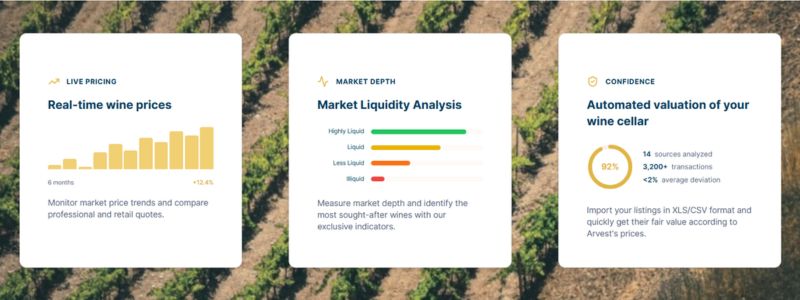
Arvest addresses this by creating a matching algorithm system, consolidating more than 15 million data points from over 300 sources and connecting market intelligence with a professional B2B transaction network.
How can the industry use data without losing the human stories and connections that make wine distinctive?
The best role for data is backstage.
Data should handle the repetitive and objective questions: Is the price consistent with the market? How active is this wine? Which vintages are available? How much inventory is currently offered? That gives sommeliers and wine professionals more time for the work that cannot be automated: tasting, understanding producers, building relationships and telling compelling stories to guests.
It can also broaden those stories. Better information may reveal an overlooked vintage, a less fashionable appellation or a mature wine offering more character and value than the latest release.
The objective is not to replace professional judgement with an algorithm. It is to give that judgement a stronger factual foundation. In my view, data and emotion are complementary: data builds confidence in the decision, while the human experience gives the wine its meaning.
What does liquidity mean in fine wine, and why should professionals pay closer attention to it?
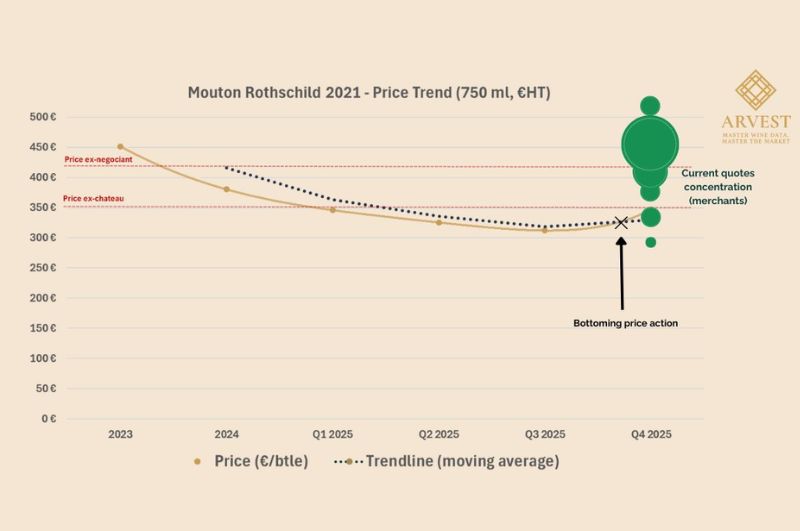
Liquidity is not a binary label. It is a three-dimensional question: how much wine can I buy or sell, at what price, and within what period of time?
A prestigious wine may have a high theoretical valuation but relatively few active buyers at that price. Conversely, another wine may trade regularly, in meaningful quantities and across several markets.
We therefore look beyond price and consider transaction frequency, available volume, active merchants, market depth, price dispersion and the size of typical transactions.
For merchants and distributors, liquidity affects working capital and inventory risk. For hospitality operators, it helps determine whether a bottle can be replenished, whether its valuation is reliable and whether dormant stock can be remarketed. A price without information about liquidity provides only part of the picture.
Source: Arvest
How can Arvest help compare a new release with available back vintages?
Arvest allows buyers to compare vintages on a like-for-like basis by format and geographic market. They can examine consolidated prices, price history, current availability, recent transaction activity, market depth, liquidity and volatility.
This creates a commercial framework around the sommelier’s qualitative assessment. The buyer can then combine the data with maturity, drinking window, stylistic profile and suitability for the restaurant’s guests.
For example, if a new release is offered at a similar price to a mature back vintage, the latest wine is not automatically the stronger purchase. The back vintage may offer greater drinking value, immediate relevance for the wine list and better market availability. Conversely, a new release may be attractive if its relative price, supply and demand indicators are compelling.
The objective is not to identify one universally “best” vintage, but the strongest proposition for a specific list, customer base and capital allocation.
How can sommeliers identify dormant inventory and improve stock rotation without aggressive discounting?
The first step is to combine internal sales velocity with external market information. A wine that has not moved internally may still have strong demand elsewhere; alternatively, it may be priced above the market or simply be presented to the wrong audience.
Sommeliers can segment inventory using two dimensions: internal rotation and external liquidity. A bottle with strong market liquidity but weak restaurant sales may require better positioning, staff engagement, a pairing, an event, or transfer to another outlet, not a discount. A wine with weak indicators on both dimensions may justify a more structural pricing decision or a B2B resale.
Arvest can support this process by valuing the cellar, comparing current pricing with the wider market, and identifying commercially inactive references. The goal is to replace blanket discounting with targeted action and release capital without unnecessarily damaging the perceived value of the wine.
Which indicators show strong commercial demand rather than prestige alone?
Strong demand is repeated, distributed, and executable.
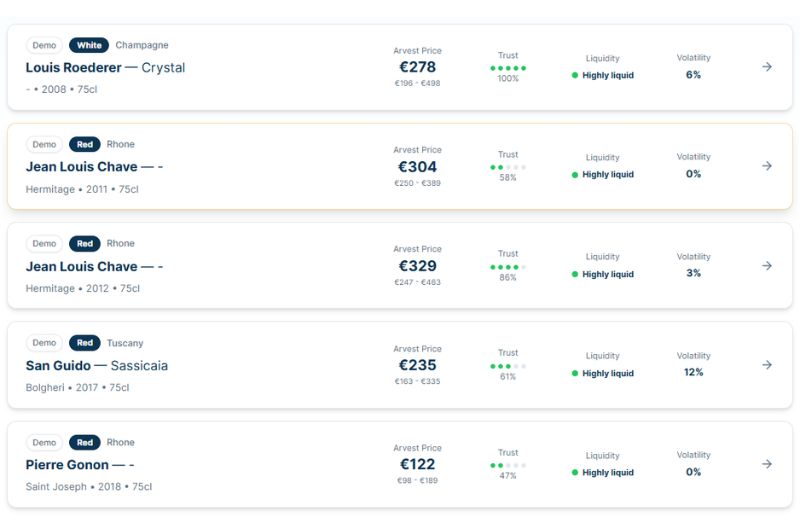
I would look for recurring transactions rather than isolated sales, participation from several independent buyers and merchants, activity across more than one geographic market, meaningful transaction sizes, and sufficient depth at prices close to the reference valuation.
The relationship between available supply and recent transaction activity is also important. A famous wine may be widely listed but trade infrequently, which can indicate that sellers’ expectations are above the level buyers will accept. Price dispersion and volatility provide additional signals: a very wide range of prices may suggest an uncertain market rather than healthy demand.
A critic score or prestigious name can help create interest, but commercial demand is demonstrated by the market’s ability to absorb actual volume consistently.
Source: Arvest
How can connections between data, warehousing, provenance and logistics improve confidence in international sourcing?
Confidence improves when the digital description of a wine remains connected to its physical location and chain of custody.
Each lot should have standardized information covering the producer, cuvée, vintage, format, quantity, condition, tax status and warehouse location. Stock verification, ownership transfer, release instructions and dispatch confirmation should then be recorded against the same reference.
Connecting these systems reduces mismatched descriptions, unavailable stock, duplicated listings and operational errors. It also allows buyers to understand the total proposition—not only the bottle price, but its location, storage status and route to delivery.
Warehouse records do not, by themselves, prove authenticity or perfect provenance. However, a consistent and auditable chain of information materially improves confidence and makes exceptions easier to identify before a transaction is completed.
Will real-time pricing and inventory data become part of sommeliers' everyday decision-making?
Yes, but it will become useful when it is embedded into the tools professionals already use.
Most sommeliers do not need a trading terminal. They need relevant information at the moment they review a supplier offer, build a wine list, conduct a stocktake or consider replacing a vintage. Pricing, availability and liquidity indicators should therefore be integrated into procurement, cellar-management and point-of-sale workflows.
Not every decision requires second-by-second data. For slower-moving inventory, a weekly or monthly update may be sufficient. The important point is that the information is current enough for the decision being made and that its methodology is transparent.
Over time, these capabilities should narrow the information gap between large merchants with dedicated data teams and hospitality businesses that currently rely on manual research.
How will technology and transparency change the way wines are valued, purchased and presented over the next five years?
I expect wine valuations to become more contextual. Instead of relying on one global headline price, professionals will increasingly consider location, tax status, condition, available volume, transaction history and liquidity.
Artificial intelligence will help normalize unstructured catalogues, match wine references and automate repetitive reconciliation. Better connections between data platforms, warehouses and logistics providers will make international purchasing faster and more traceable.
For restaurants, the wine list will increasingly be managed as a living portfolio. Buyers will compare new releases with back vintages, monitor dormant inventory and adjust sourcing based on both guest demand and market conditions.
Greater transparency will not make fine wine a commodity. On the contrary, as basic information becomes easier to access, curation, service, producer relationships and storytelling will become even more valuable. Technology should remove friction around the wine so that professionals can focus more attention on the experience it creates
Header image source: Etienne Lefebvre
Also Read:
Why the UK's Best Bars Will Win Through People, Not Products
The Most Profitable Beverage Trends Restaurants Can’t Ignore
The Perfect Low-ABV Drink: Why Young Consumers Love Flavoured Soju
TAGS: